Singapore February 3 (AseanAll) — The MERCOSUR-Singapore Free Trade Agreement (MCSFTA) entered into force for Singapore and Paraguay on 1 February 2026.
MERCOSUR is a South American trade bloc founded by Argentina, Brazil, Paraguay and Uruguay. The MCSFTA is Singapore’s 29th free trade agreement and first trade deal with the founding MERCOSUR Member States, as well as MERCOSUR’s first free trade agreement with a Southeast Asian country.
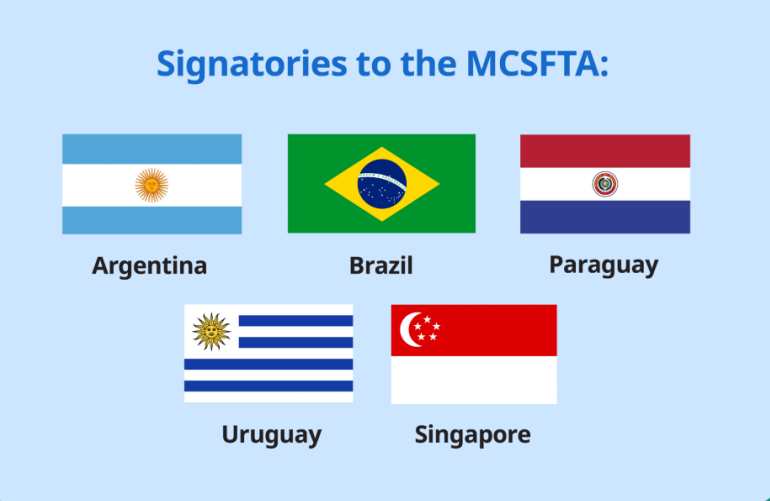
Following the completion of Uruguay’s ratification procedure, the MCSFTA will also enter into force for Singapore and Uruguay on 1 March 2026. Ratification procedures are ongoing for Argentina and Brazil.
The MCSFTA aims to deepen economic integration between Singapore and the four South American economies by facilitating greater trade flows through lowered tariff rates, establishing transparent and predictable investment conditions, and fostering cooperation in areas such as trade facilitation, entrepreneurship, digitalisation, sustainable development, food supply security and development of small and medium enterprises.
MERCOSUR has a combined gross domestic product (GDP) of nearly US$3 trillion and a population of over 295 million in 2025. Close to 200 Singapore companies are operating across the MERCOSUR markets and Singapore’s total trade in goods with the four MERCOSUR member states amounted to S$11.9 billion, which represented over 30% of Singapore’s total trade with Latin America in 2025.
The MCSFTA was signed by Minister for Foreign Affairs Dr Vivian Balakrishnan and Ministers from the founding MERCOSUR Member States at the 63rd Summit of Heads of State of MERCOSUR and Associate States on 7 December 2023.
What is the MERCOSUR-Singapore Free Trade Agreement (MCSFTA)?
• The MERCOSUR-Singapore Free Trade Agreement (MCSFTA) is a comprehensive Free Trade Agreement between Singapore and the four founding MERCOSUR member states – Argentina, Brazil, Uruguay, and Paraguay. It comprises the following 15 Chapters, excluding the Chapters on legal and institutional issues:
1. National Treatment and Market Access for Goods
2. Rules of Origin
3. Trade Remedies
4. Bilateral Safeguards
5. Customs Procedure and Trade Facilitation
6. Technical Barriers to Trade
7. Sanitary and Phytosanitary Measures
8. Trade in Services
9. Movement of Natural Persons
10.Investment
11.E-Commerce
12.Intellectual Property Rights
13.Government Procurement
14.Micro, Small and Medium Enterprises (MSMEs)
15.Competition Policy
• Following four years of negotiation, the MCSFTA was concluded on 22 July 2022, and signed on 7 December 2023 by Singapore’s Minister for Foreign Affairs Dr Vivian Balakrishnan and the Ministers from the founding MERCOSUR Member States, at the 63rd Summit of Heads of State of MERCOSUR and Associate States in Rio de Janeiro, Brazil.
Key Benefits of the MCSFTA
• As the first Free Trade Agreement between Singapore and all four founding MERCOSUR member states, the MCSFTA will enhance our trade architecture with South America and provide our traders and investors with clearer and more transparent access to each other’s markets. Key benefits of the MCSFTA include:
1. Trade in Goods. The founding MERCOSUR states will gradually eliminate import tariffs on approximately 96% of products over 15 years, offering immediate tariff-free access for around 20% of products. This marks a significant increase in tariff-free market access, up from less than 15% of Singapore’s exports to the MERCOSUR markets currently.
2. Customs Procedures and Trade Facilitation. Businesses can enjoy simplified and expedited customs procedures for express shipments. Both sides have committed to expediting the release of perishable goods within the shortest possible time, which is especially important for exporters of agricultural products such as dairy and fresh produce.
3. Rules of Origin. Singapore exporters can enjoy flexible rules of origin for their goods to qualify for preferential tariffs when imported by the founding MERCOSUR states.
4. Government Procurement. Singapore businesses are ensured fair and nondiscriminatory treatment when competing for government contracts. This gives companies an equal opportunity to gain access to MERCOSUR’s Government Procurement markets.
5. Trade in Services. Service suppliers can expect equal treatment as their counterparts in various sectors, including computer, R&D, and construction services.
6. Investment. Investors can enjoy enhanced stability and predictability through the provision of clearer market entry conditions. This Chapter is Singapore’s first investment agreement with the founding MERCOSUR states.
7. Micro, Small, and Medium Enterprises (MSMEs). The MCSFTA will facilitate cooperation in capacity building to support the growth, competitiveness, and internationalisation of MSMEs. Singapore and the founding MERCOSUR states will exchange information relevant to MSMEs, explore avenues for collaboration, and help MSMEs develop entrepreneurial skills.
8. E-Commerce. The MCSFTA will promote digital trade facilitation, including electronic authentication and paperless trading, as well as enhance trust in the digital economy, such as through stronger online consumer protection and minimising unsolicited commercial electronic messages. Singapore and MERCOSUR have also agreed to cooperate in various areas relating to ecommerce, including cybersecurity.
9. Competition. Singapore and the founding MERCOSUR states have committed to adopt or maintain competition laws that prohibit anti-competitive business conduct so that businesses can enjoy fair competition.