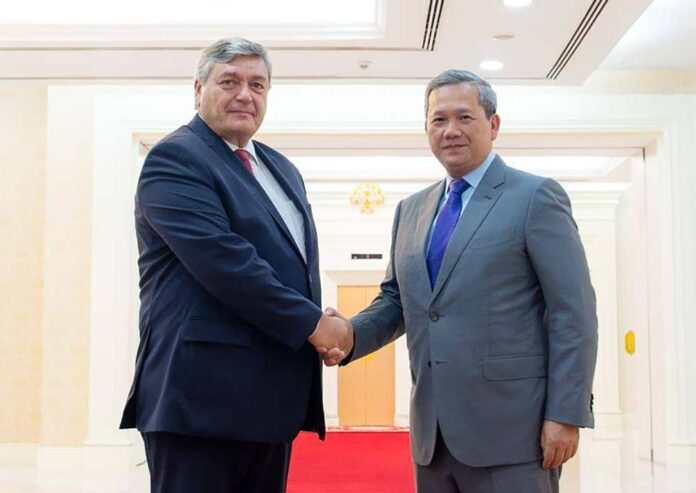
Phnom Penh, August 24 (AseanAll) — On the afternoon of 24 August 2026, HUN Manet, Prime Minister of the Kingdom of Cambodia, received a courtesy call from Andrey RUDENKO, Deputy Minister of Foreign Affairs of the Russian Federation, at the Peace Palace.
During the meeting, the Deputy Minister expressed his appreciation for the relations and cooperation between the two countries, emphasising that Cambodia is a long-standing and trusted partner in the Asia-Pacific region. He also recalled the history of bilateral relations, including the support provided by the former Soviet Union and the Russian Federation in restoring, rebuilding, and contributing to Cambodia’s socio-economic development following the country’s liberation.
At the same time, Andrey RUDENKO commended Cambodia’s rapid development and expressed optimism that the Royal Government of Cambodia would overcome challenges to further improve the livelihoods of its people. He expressed confidence that Russia–Cambodia relations would continue to grow and that the two countries will further deepen cooperation in various potential areas.
The Deputy Minister also highlighted the continued provision of scholarships for Cambodian students to pursue their studies in the Russian Federation. Furthermore, he briefed HUN Manet on the fruitful outcomes of the 3rd Bilateral Consultations between the Ministries of Foreign Affairs of the two countries, which would further contribute to advancing bilateral cooperation.
In response, HUN Manet expressed his gratitude to the Russian Federation and the former Soviet Union for their important contributions to Cambodia’s socio-economic restoration and development, as well as for the continued provision of scholarships to Cambodian students.
HUN Manet also highly appreciated the outcomes of the bilateral consultations hosted by Cambodia on this occasion and reaffirmed his commitment to elevating bilateral cooperation to a new level.
Before concluding the meeting, HUN Manet and the Deputy Minister exchanged views on further strengthening and expanding cooperations in key areas, including trade and investment, education, energy, people-to-people exchanges, tourism, agriculture, security, and defence.