ASEAN Chair’s Statement
on the Outcomes of the Special Asean Foreign Ministers’ Meeting on the Situation in the Middle East
13 March 2026
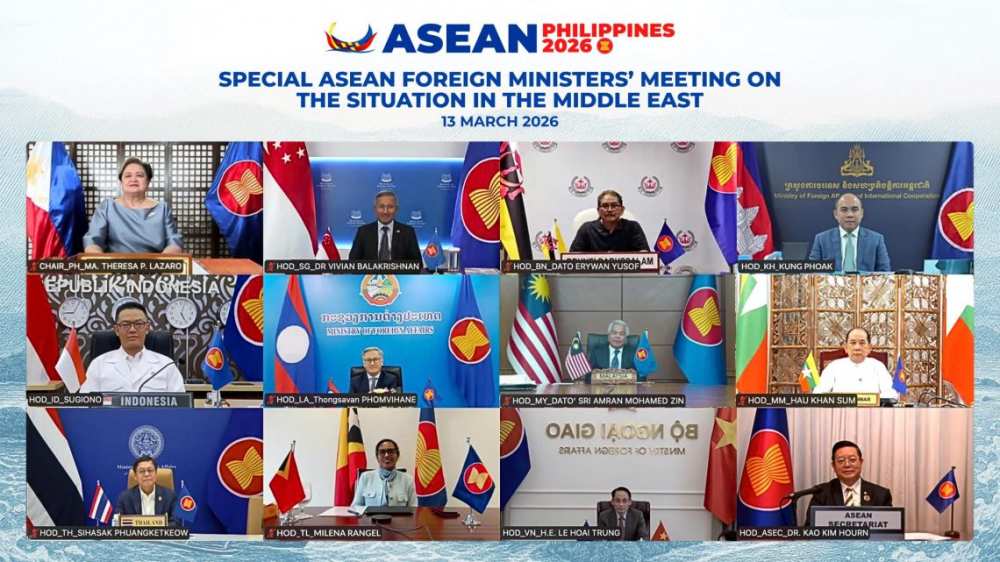
1. The ASEAN Foreign Ministers convened a Special Meeting on 13 March 2026, via videoconference, to exchange views on the evolving situation in the Middle East and to address its implications for ASEAN.
2. The Meeting expressed serious concern over the escalation of conflict in the Middle East following the attacks initiated by Israel and the United States against the Islamic Republic of Iran on 28 February 2026, and Israeli attack on the Lebanese Republic, and the subsequent retaliatory attacks by the Islamic Republic of Iran against several countries in the region, including the Kingdom of Bahrain, Hashemite Kingdom of Jordan, the Republic of Iraq, State of Kuwait, Sultanate of Oman, State of Qatar, Kingdom of Saudi Arabia, Syrian Arab Republic, and the United Arab Emirates, which continue to heighten tensions in the Middle East, and pose a grave threat to the lives and safety of civilians, as well as to regional and global peace and stability. The Meeting called on all countries to respect international law, including the Charter of the United Nations (UN Charter).
3. The Meeting emphasised the importance of an immediate cessation of hostilities and called on all parties concerned to exercise utmost self-restraint, avoid any acts that may further aggravate the situation, and resolve differences through diplomacy and dialogue in the interest of maintaining peace and stability in the region.
4. The Meeting reaffirmed the obligation of all States to resolve their differences through peaceful means and to respect the sovereignty and territorial integrity of all nations, in line with international law, including the UN Charter. The Meeting further reiterated the obligations to protect civilians and civilian infrastructures in armed conflicts consistent with international law and relevant UN Security Council resolutions.
5. The Meeting also discussed the safety and welfare of ASEAN nationals in the affected areas and re-emphasised the shared commitment to provide emergency assistance to ASEAN nationals, especially during this time, in accordance with the ASEAN Declaration on the Guidelines on Consular Assistance by ASEAN Member States’ Missions in Third Countries to Nationals of Other ASEAN Member States and the Guidelines for the Provision of Emergency Assistance by ASEAN Missions in Third Countries to Nationals of ASEAN Member Countries in Crisis Situations. We acknowledged the assistance and efforts made by our fellow ASEAN Member States in this regard. The Meeting also underlined the importance of exploring the possibility of mutually beneficial collaboration with external parties.
6. The Meeting discussed the impacts of the conflict in the Middle East on global economic activity, particularly energy markets and maritime and air transport routes, and underscored the importance of maintaining stable, open, and reliable global energy supply chains and maritime trade routes, and minimising disruption to the flow of energy and essential goods, including food, to safeguard economic stability in ASEAN.
7. The Meeting underscored the importance of strengthening regional energy security and economic resilience and emphasised the value of ASEAN solidarity, economic integration, and coordination in policy and joint effort to navigate external economic shocks and mitigate their potential impact and spillover effects on regional macroeconomic and financial stability, including finance sectors, supply chains, the cost of living as well as the lives of people across ASEAN. The Meeting highlighted the importance of strengthening regional connectivity, enhancing cooperation on energy preparedness, and advancing efforts to diversify energy sources, including renewable and alternative energy, and further emphasised the importance of facilitating trade, strengthening logistics connectivity, and reinforcing supply chain resilience to help ensure stable access to affordable essential goods, especially food and food products, across ASEAN.
8. The Meeting called for making full use of existing ASEAN mechanisms and frameworks to enhance consultation, information sharing, and cooperation among ASEAN Member States and emphasised that ASEAN already possesses practical mechanisms and initiatives that can be further mobilised and strengthened to enhance regional resilience, including the ASEAN Framework Agreement on Petroleum Security (APSA), the ASEAN Power Grid (APG) Enhanced Memorandum of Understanding, and the Trans-ASEAN Gas Pipeline (TAGP), as well as cooperation with relevant sectoral bodies and industry stakeholders. The Meeting committed to intensify synergy among relevant ASEAN sectoral bodies, including those responsible for economic, finance, transport, food and agriculture and energy cooperation, in order to strengthen regional preparedness and resilience. The Meeting stressed the importance of deeper cooperation under the ASEAN Economic Community in sustaining ASEAN’s role as a reliable hub for trade, investment, and production networks amid evolving global challenges, as well as closer coordination between ASEAN Foreign and Economic Ministers to promote a more synergised and timely response to crises, and in this regard, welcomed the issuance of the Joint Statement of the ASEAN Economic Ministers on Strengthening ASEAN’s Economic Resilience in Response to Recent Global Economic and Geopolitical Developments. The Meeting also reiterated the importance of cross-pillar cooperation among the ASEAN Political-Security Community, the ASEAN Economic Community and the ASEAN Socio-Cultural Community in order to effectively address the evolving geo-political and geo-economic challenges.
9. The Meeting underscored the importance of maintaining regional peace, stability and prosperity, upholding international law, and promoting dialogue and diplomacy as the primary means of addressing conflicts and tensions. The ASEAN Foreign Ministers agreed to continue to monitor the situation in the Middle East and to coordinate to address its implications for ASEAN.
Soruce:Department of Foreign Affairs, Republic of the Philippines