(AseanAll) — On March 12, 2024, at Palais des Festivals, Cannes, Republic of France, Thai Prime Minister and Minister of Finance Srettha Thavisin attended the opening of MIPIM 2024, the world's leading real estate market event, and delivered an opening keynote on “Better Infrastructures in an Age of Risk, Scarcity and Emergency” to share his vision and experience regarding infrastructure development.
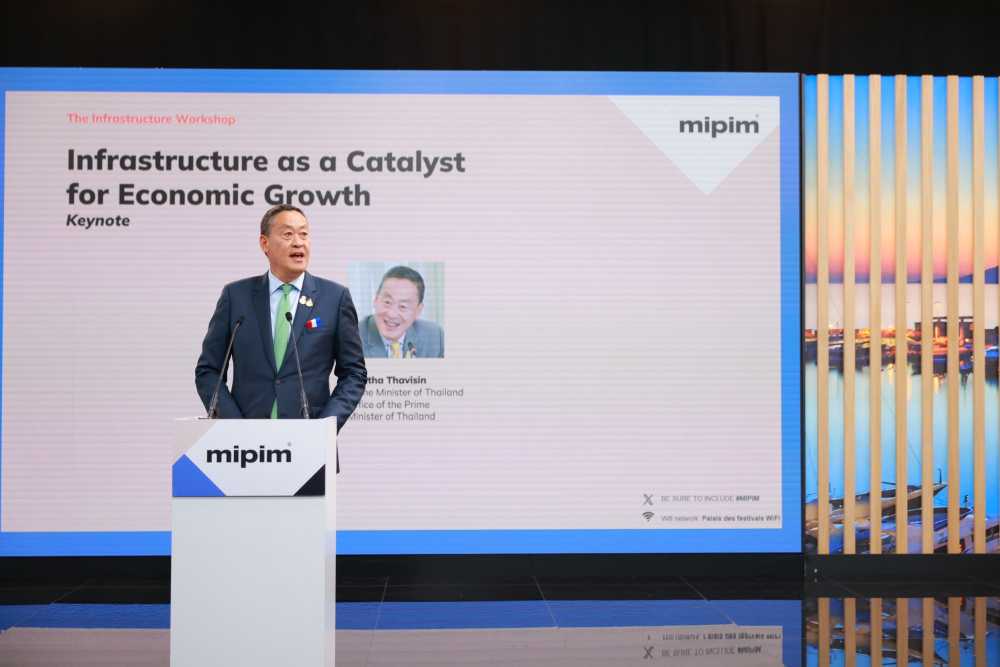
The Prime Minister highlighted infrastructure development as a key priority for Thailand. One of the central goals of the Thai Government is to foster equality through economic growth, as it firmly believes that infrastructure is at the heart of enabling progress and access across all sectors of the economy. Well-executed infrastructure projects can lead to immense economic and social benefits not only for those living in major cities but also opportunities for everyone everywhere.
Thailand’s most recent mega infrastructure project was 18 years ago with the opening of Suvarnabhumi International Airport in Bangkok. This significantly widened the gate to the country. In the decade prior to the airport's completion, the number of visitors grew by 71%. However, the decade afterwards saw a growth of almost 110%. Over the years, this has enabled Thailand to become a top global travel destination.
According to the Prime Minister, the vital importance of infrastructure and its far-reaching impact has been recognized, benefiting not just tourism but also multidimensional industries including real estate. In this age of risk, scarcity, and emergency, having resilient and sustainable infrastructure is invaluable. It keeps everyone connected and serves as a crucial backbone for a society. The Prime Minister, then, shared the government’s vision and its upcoming major infrastructure investments which will make Thailand the logistics hub of Southeast Asia.
First, the Thai Government plans to turn Thailand into the main regional aviation hub within this decade. Geographically situated in the heart of Indochina, Thailand holds a strategic position where major cities across Asia are within a 4 to 6-hour flight. With Bangkok alone welcoming over 60 million passengers annually, Thailand aspires to further expand its capacity to accommodate even more travelers. Plans are in place to expand existing airports and construct new ones. A notable project is the expansion of Suvarnabhumi International Airport to add new terminals and build 2 more runways. Once completed, the airport will be able to handle 150 million passengers yearly, more than double of what the airport can handle today.
Additionally, Thailand will also build two new airports -- one in the north and one in the south. The Lanna International Airport will serve as a second airport to the bustling tourism industry in Chiang Mai and other northern provinces. Meanwhile, the Andaman International Airport in Phang-nga, close to Phuket, will complement the long-haul hub in southern Thailand. Together, these new airports will accommodate an additional 40 million passengers annually.
In addition to new infrastructure, the Government also has plans to improve the services for every visitor who goes through the country’s airports. This includes:- Improving ground operation processes and capacity to shorten the wait time for inbound and outbound passengers.
- Expanding and reallocating landing and take-off slots to make it more suitable and convenient for international passengers.
- Reducing landing fees and increasing delay fees to increase turnover and accommodate more flights.
- Improving safety standards for both ground operations and airside operations.
- Increasing flight frequency and new routes to Thailand, and much more.
With these large investments in infrastructure and services, the Prime Minister expressed belief that Thailand is well-positioned to lead the region as its aviation hub.
Second, another mega project the Thai Government is undertaking is the Landbridge Project – the cornerstone of maritime connectivity in the Indo-Pacific. The Prime Minister emphasized a huge risk posed by solely relying on the Malacca Strait to travel between the Indian and the Pacific Oceans. Currently, 25% of the world's cargos flows through this narrow strait. Each year, 90,000 vessels have to navigate through this already congested waterway, resulting in slow-moving traffic and significant queuing. Under the plan, roads and high-speed rails will connect two deep-sea ports, cutting across southern Thailand and providing an alternative connecting point between the two oceans. This project is not only important from a commercial standpoint, but is also critical in maintaining global trade and supply chain stability amidst global geopolitical uncertainties. The Thai Government is confident that the Landbridge project will be a success and a proud jewel of Southeast Asia, especially with Thailand as a neutral party, Thailand’s Landbridge will always be open to everyone.
Third, the Prime Minister pointed out that the future of infrastructure could not be discussed without discussing renewable energy. It is clear that most major projects and investments from now on will require affordable and reliable access to renewable energy. Over the past few years, the Government has heavily invested to ensure that Thailand will achieve the ambitious target of having 50% of our energy production be renewable by 2040. The country is also among the first nations to launch a “Utility Green Tariff” scheme. This ensures that anyone who invests in Thailand will have access to renewable energy in the years to come.
In conclusion, Thailand’s ambitious infrastructure projects are pivotal not only for the country's economic growth, but also for commitment to sustainability and equitable development. The Government is not only building infrastructure, but also forging connections that bridge economies and peoples, shaping a sustainable and prosperous future. The Prime Minister expressed hope that the participants think about how they can get involved to turn these ambitious visions into reality, making Thailand a model of progress and sustainability.
.............
MIPIM 2024 is the world's leading real estate market event, held on March 12-15, 2024. It covers a vast exhibition area of over 18,700 square meters, and features a number of conferences, workshops, forums, and networking events where leaders, experts, and visionaries in the real estate industry engage.