JOINT STATEMENT
OF THE HIGH-LEVEL STRATEGIC COOPERATION COUNCIL MEETING
BETWEEN
THE REPUBLIC OF TÜRKİYE AND MALAYSIA
(Ankara, 7 January 2026)
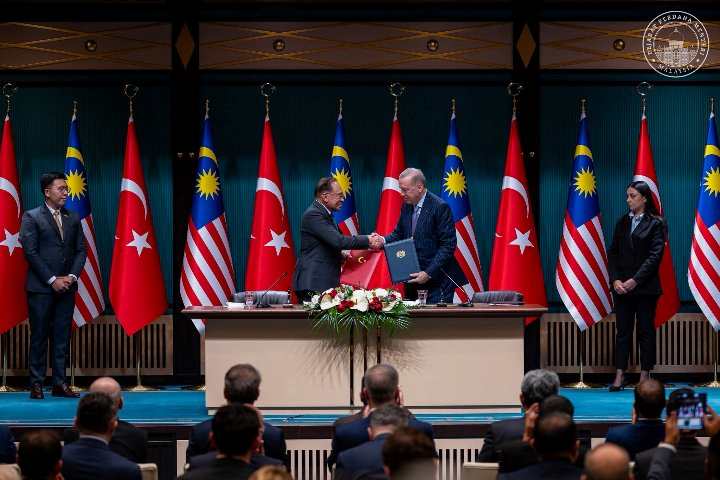
Photo source: Anwar Ibrahim Facebook
1. H.E. Recep Tayyip Erdoğan, President of the Republic of Türkiye, and H.E. Dato’ Seri Anwar Ibrahim, Prime Minister of Malaysia, met in Ankara on 7 January 2026 to co-chair the inaugural session of the High-Level Strategic Cooperation Council (HLSC), established within the framework of the two countries’ comprehensive strategic partnership. The meeting marked a significant milestone in Türkiye–Malaysia relations, providing a platform to evaluate bilateral cooperation and chart new pathways for deeper collaboration in the years ahead.
Deepening Comprehensive Strategic Partnership
2. The Leaders reaffirmed the longstanding friendship, shared democratic principles, and cultural connections that underpin the relationship between Türkiye and Malaysia. They emphasized their mutual commitment to promoting peace, stability and prosperity at the bilateral, regional, and global levels.
Both Leaders also expressed satisfaction with the agreements signed during the visit in the fields of trade and investment, information and communication technologies, and defence industry.
Advancing Economic Cooperation, Investments and Connectivity
3. The two sides noted the steady growth in bilateral trade and reiterated their joint ambition to reach the target of USD 10 billion. They highlighted the importance of making full use of the Malaysia–Türkiye Free Trade Agreement, and expanding cooperation into new sectors, including agriculture, manufacturing, digital trade and services. The Leaders further reaffirmed their commitment to strengthening collaboration in the growing global halal economy.
4. Türkiye and Malaysia emphasized the importance of deepening bilateral investments and agreed to expand cooperation across logistics, maritime connectivity, port development, aviation, multimodal transport, and emerging economic corridors linking Europe, the Middle East, and the Asia-Pacific. In this context, the Leaders highlighted the role of civil aviation in enhancing connectivity and encouraged continued consultations between the civil aviation authorities to support efficient and sustainable air transport operations, including air cargo and passenger services. They welcomed the engagement between the business communities of both countries during the Türkiye–Malaysia Business Roundtable held on this occasion.
5. The Leaders agreed to promote cooperation in the area of Small and Medium-sized Enterprises (SMEs) development through the responsible organizations and to encourage interaction and cooperation between SMEs in both countries.
Enhancing Defence and Security Cooperation
6. The Leaders recognized the strategic bilateral defence cooperation, particularly in military and defence science, technology and industry as a means of enhancing national defence capabilities and contributing to regional and global stability. They agreed to deepen collaboration on mutually beneficial high-technology projectsin strengthening the joint defence industry ecosystem. Both sides also committed to enhancing military capacity building through educational and training opportunities for Turkish and Malaysian cadets and officers in Malaysian and Turkish institutions.
7. The Leaders reiterated their shared commitment to combating transnational organized crime and terrorism in all its forms and manifestations and emphasized the importance of international cooperation to address evolving security challenges.
Working Together on Energy, Climate Change, Sustainable Development, and Emerging Technologies
8. Both sides affirmed their will to develop potential cooperation on energy transition, electricity, energy efficiency, nuclear energy, renewable energy, clean hydrogen, and battery technologies.
9. Türkiye and Malaysia reaffirmed their shared responsibility to address climate change and advance sustainable development in line with the Paris Agreement and the Sustainable Development Goals. In this context, both sides welcomed opportunities for continued engagement on climate change, in the run-up to Türkiye’s Presidency of the 31st Conference of the Parties (COP31) under the United Nations Framework Convention on Climate Change (UNFCCC).
10. Commending the valuable support of Malaysia for UN Resolution 77/161 entitled “Promoting zero-waste initiatives to advance the 2030 Agenda for Sustainable Development” and for "Global Commitment to Zero Waste for the World, Our Common Home", both sides expressed their readiness to cooperate closer and share best practices on Zero Waste.
11. Two sides underscored the importance of development assistance cooperation, including joint initiatives towards third countries.
12. Recognizing that emerging technologies hold transformative potential, the Leaders expressed their intention to expand cooperation in science, technology, and innovation (STI), particularly in artificial intelligence, information and communication technologies, semiconductors, space and satellite technologies, biotechnology, and digitalization. They also underscored the importance of strengthening joint research & development efforts and developing shared platforms to support innovation.
Strengthening People-to-People Ties
13. The Leaders praised the vibrant cultural, academic collaboration, as well as tourism exchanges between Türkiye and Malaysia, noting that ties between nations are ultimately sustained by the goodwill of their peoples.
Türkiye wished success for “Visit Malaysia 2026” and supported this initiative. Both sides agreed to explore further collaboration in tourism, including health, wellness, and digital tourism.
They highlighted the work of educational and cultural institutions in promoting mutual understanding and emphasized the value of student mobility, higher education scholarship opportunities, cultural exchange programs and the establishment and/or support of alumni associations in both countries.
Joint Efforts in the Field of Media and Communication
14. The two sides underlined the importance of media and communication, including public diplomacy practices in enhancing mutual understanding, and stressed the need for cooperation in addressing disinformation and reinforcing public relations capacities through joint media projects, strategic communication, and people-to-people engagement.
Cooperation on Family, Social Development, and Inclusive Social Protection Policies
15. The Leaders reaffirmed the importance of cooperation in the field of social development, including policies and programs aimed at strengthening families, empowering women, protecting children, and enhancing the well-being of older persons and persons with disabilities.
They reiterated their shared commitment to promoting the exchange of experiences and best practices in social services, family-oriented policies, and inclusive social protection systems, and expressed their intention to further deepen such cooperation with a view to fostering resilient, cohesive, and inclusive societies.
Cooperation on Regional and Global Issues
16. The two sides reaffirmed their shared commitment to promoting peace, stability, and multilateralism. They agreed to strengthen coordination in the UN, OIC, D-8, and other multilateral platforms. The Leaders also emphasized the importance of comprehensive UN reform, particularly reforming the UN Security Council to make it more legitimate, representative, democratic, accountable and transparent that corresponds with the current geopolitical realities and dynamics.
17. Malaysia reiterated its support for Türkiye’s aspiration to become an ASEAN Dialogue Partner, recognizing Türkiye’s potential contribution to regional cooperation and development. Türkiye thanked Malaysia for its continuous support and guidance for increased engagement of Türkiye with ASEAN during the ASEAN Chairmanship of 2025.
18. On regional issues, the Leaders reaffirmed unwavering support for the Palestinian people and for the establishment of an independent State of Palestine based on the pre-1967 borders with East Jerusalem as its capital. They condemned Israel’s genocide in Gaza and violations of international humanitarian law in the West Bank, and called for full adherence to the ceasefire achieved at the Sharm Al-Sheikh Summit. The two sides underlined the importance of urgent, safe, sustained and unimpeded humanitarian access throughout Gaza.
19. The Leaders reiterated importance of preserving Syria’s territorial integrity, unity and sovereignty, and highlighted their support to Syrian government’s continued efforts for an inclusive political process. They underlined the importance of international cooperation to create necessary conditions to ensure safe and voluntary return of refugees in a sustainable form and to eliminate terrorism in all its forms and manifestations in the region. The Leaders also emphasized the importance of sustained support for early recovery and reconstruction efforts in the country.
Looking Ahead
20. The First High-Level Strategic Cooperation Council laid the foundation for a comprehensive roadmap to deepen bilateral ties in the coming decades. The Leaders instructed the Ministers of Foreign Affairs to convene the Joint Commission Meeting by the end of 2026 to follow up on the outcomes of the First HLSC.
They agreed that the Second High-Level Strategic Cooperation Council Meeting will be held in Malaysia in 2028.
Source: Ministry of Foreign Affairs of Malaysia