Jakarta, August 4 (AseanAll) — On August 4, 2026, at Nusantara Hall, ASEAN Secretariat, Jakarta, Republic of Indonesia, Thai Prime Minister and Minister of Interior Anutin Charnvirakul delivered Thailand’s vision on the future of ASEAN. Participating in the session were Permanent Representatives to the ASEAN Secretariat and interested diplomats from over 100 countries. This statement delivery marks the first time in 17 years since 2009 that a Thai Prime Minister has delivered a speech at the ASEAN Secretariat.
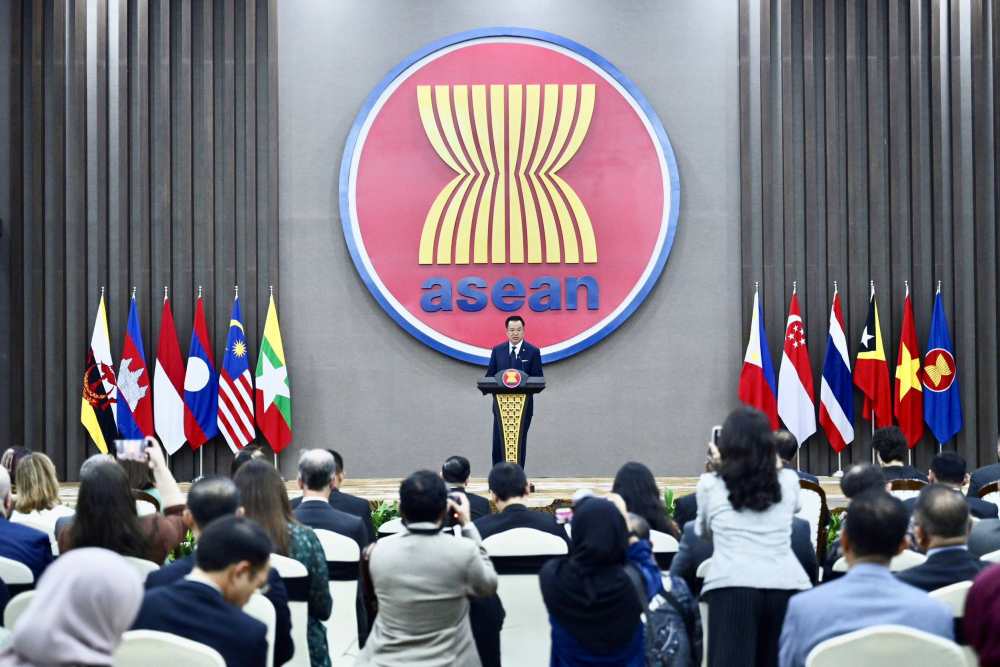
On this occasion, the Prime Minister presented 3 key priorities for ASEAN to respond to global challenges, maintain its regional leadership, and engender tangible benefits for the people. Government Spokesperson Rachada Dhnadirek disclosed gist of the vision as follows:
According to the Thai Prime Minister, “Regional challenges require regional solutions.” The world is currently facing interconnected challenges in geopolitics, economics, technology, and security. These issues cannot be resolved by one country alone. Three key priorities ASEAN should advance to address those challenges are:
Stronger regionalism: In a fragmented world, ASEAN’s unity and centrality matter more than ever. ASEAN principles of consensus and noninterference remain fundamental, but they must be applied with the flexibility and pragmatism needed to preserve unity and enable meaningful action.
The issue of Myanmar is a clear test. The Five-Point Consensus remains ASEAN's guiding framework. Thailand has advocated a calibrated re-engagement approach that keeps dialogue open and responds to realities on the ground while encouraging concrete progress.
This approach appears to be moving in the right direction, as yesterday the ICRC was allowed to meet Daw Aung San Suu Kyi, where she appears to be in good health. This has been what Thailand has advocated for all along. Thailand hopes to see more positive progress in the near future. A peaceful and stable Myanmar is not only in Thailand’s interests as a close neighbor it is essential to ASEAN’s unity and regional stability.
The same principle applies when differences arise between ASEAN Member States. They must be managed peacefully, in good faith, between the concerned countries. When the Prime Minister met with the Cambodian counterpart in Cebu, both leaders agreed to restore trust and confidence, and give bilateral talks a chance. The Compulsory Conciliation that Cambodia has initiated runs counter to what the two countries agreed. Thailand stands ready to turn a new page with the neighbor, and remains committed to resolving differences peacefully and in accordance with international law, while safeguarding ASEAN’s unity and shared regional agenda.
Greater resilience: Resilience is no longer just about recovering from crises. It means making preparations before disruption arrives. ASEAN must deepen integration and strengthen the foundations of its security and prosperity through building trusted supply chains, reliable energy, food security, digital connectivity, and technological capability.
But resilience cannot be built in isolation. ASEAN must widen its partnerships with middle powers and partners across the Global South who share the commitment to an open, inclusive and rules-based international order. By connecting strengths and diversifying cooperation, ASEAN can create more options, reduce overdependence and preserve its strategic autonomy.
Lasting Relevance: ASEAN’s success must be measured by outcomes that people can truly experience, i.e., food and energy security; effective responses to transnational crime and emerging threats; job creation and economic opportunities; and skill development to prepare the younger generations for the fast-changing technology and digital economy.
At the same time, ASEAN must strengthen its institutions and working mechanisms so that decisions become action and genuine benefits can be delivered to the people.
ASEAN is a regional cooperation framework of which Thailand is a founding member. This milestone transformed a region once marked by conflict into a community committed to rules, cooperation, and dialogue. Over the years, Thailand has played an important role in ASEAN’s development at various stages, be it, the establishment of the ASEAN Free Trade Area (AFTA) and ASEAN Regional Forum (ARF). It also took part in laying foundation for the ASEAN Intergovernmental Commission on Human Rights (AICHR).
Next year, ASEAN will mark its sixtieth anniversary. That milestone should renew the purpose for the decades ahead. Thailand has helped ASEAN move forward at defining moments in the past. As ASEAN reaches another crossroads, the country stands ready to do so again. Thailand will help build an ASEAN that draws strength from within, stands firm under pressure, preserves its strategic autonomy through wider partnerships, and remains relevant to ASEAN people and to the world.
This is the future of ASEAN that Thailand believes in. More importantly, it is the future ASEAN member countries must build together.