(AseanAll) —The Government of Timor-Leste and the private sector agreed to implement five joint commitments aimed at developing the national economy, as part of the public-private dialogue held on March 23rd, 2026, at the Dili Convention Centre, following the release of the 2025 Report on Timor-Leste’s Economic Performance by the Central Bank of Timor-Leste.
The commitments were formalised in a document signed by the Minister of Trade and Industry, Filipus Nino Pereira, and the President of the Chamber of Commerce and Industry of Timor-Leste, Jorge Manuel de Araújo Serrano, in the presence of Prime Minister Kay Rala Xanana Gusmão, Vice Prime Minister and Coordinating Minister of Economic Affairs Francisco Kalbuadi Lay, and Governor of the Central Bank of Timor-Leste, Helder Lopes.
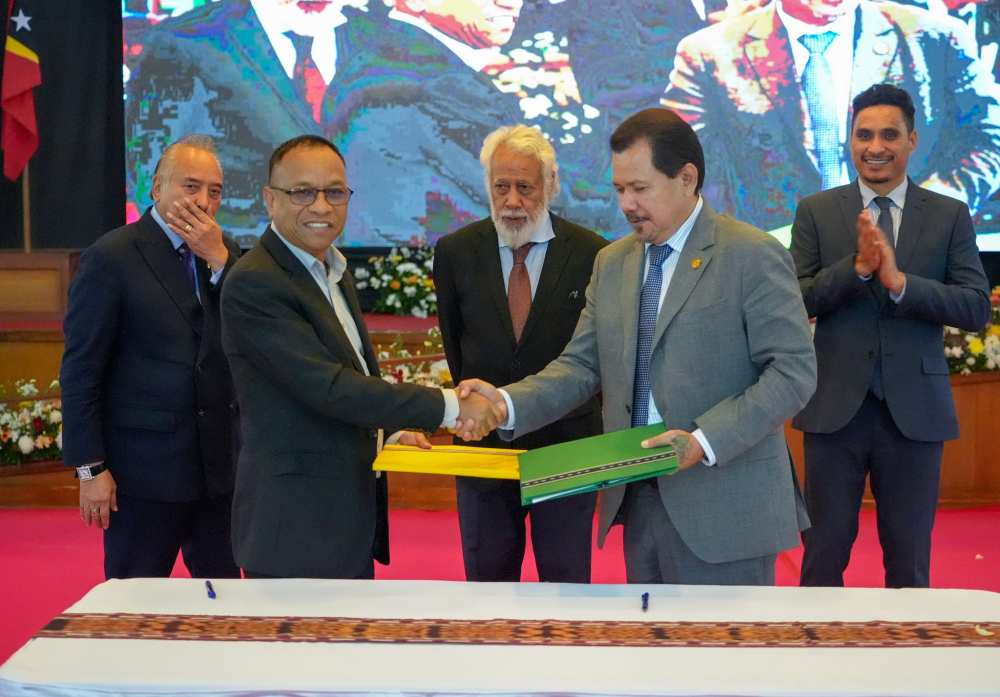
The agreement creates a framework for collaboration between the Government and the private sector aimed at fostering economic growth driven and sustained by private investment, with an emphasis on diversification, resilience, and inclusion.
Under this agreement, five areas of joint action have been identified.
The first commitment concentrates on reforming the business environment's structure, implementing measures to simplify and digitalise administrative processes, increase transparency, cut down bureaucracy, and boost legal certainty and predictability for investors.
The second commitment aims to boost investment in productive sectors by promoting economic diversification and increasing investment in agriculture, commerce, industry, tourism, and services. It also seeks to foster the development of micro, small, and medium-sized enterprises, as well as promote innovation and digitalisation.
The third commitment emphasises promoting access to financing, including facilitating credit mechanisms for domestic businesses—particularly micro, small, and medium-sized enterprises—developing financial instruments, and strengthening financial inclusion.
The fourth commitment focuses on improving market access by boosting domestic production, encouraging exports, attracting foreign investment, and integrating local companies into regional and global value chains.
The fifth commitment advocates setting up a lasting public-private dialogue platform to identify obstacles, develop evidence-based solutions, and oversee the implementation of reforms.
The agreement forms part of Timor-Leste’s accession to the World Trade Organisation and its integration into ASEAN, which creates new investment opportunities and enhances market access. It also strengthens coordination between the Government and the private sector in establishing economic priorities.