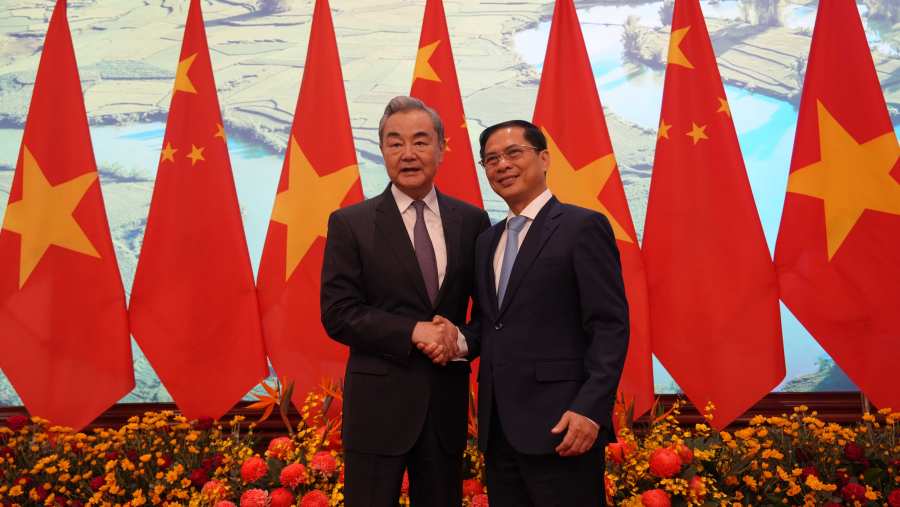
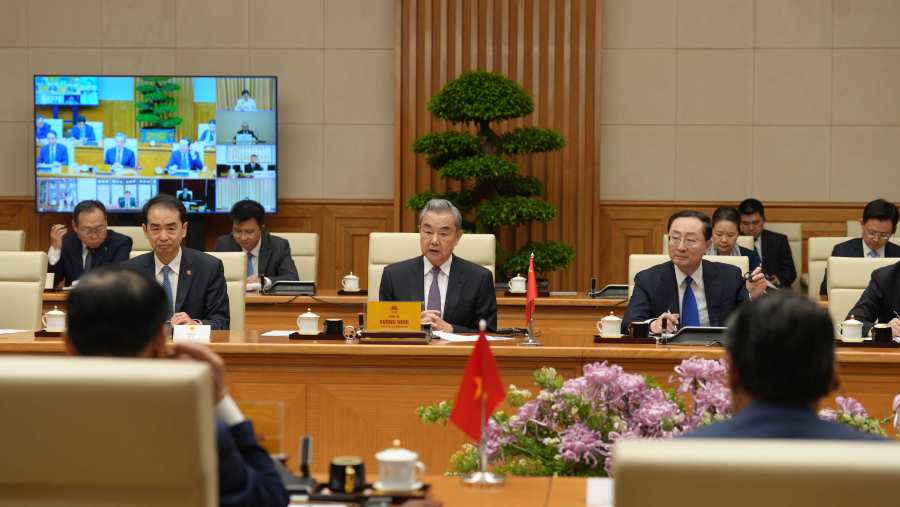
Hanoi, March 17 (AseanAll) — On March 17, 2026, local time, the 17th meeting of the China-Viet Nam Steering Committee for Bilateral Cooperation was held in Hanoi, Viet Nam. The meeting was co-chaired by Member of the Political Bureau of the CPC Central Committee and Chinese Foreign Minister Wang Yi and Vietnamese Deputy Prime Minister Bui Thanh Son, and attended online and offline by responsible officials of multiple ministries and sub-national departments from both sides.
Wang Yi said that in April last year, Chinese General Secretary and President Xi Jinping paid a successful state visit to Viet Nam. Following the 14th National Congress of the Communist Party of Viet Nam (CPV) earlier this year, President Xi again held a phone call with General Secretary To Lam, charting a blueprint for the development of socialism in both countries and China-Viet Nam relations in the new era. Efficient coordination between departments and localities of both countries, along with the quality improvement and upgrading of all-around cooperation, has made the establishment of a China-Viet Nam community with a shared future more substantial, higher in quality, and more dynamic.
Wang Yi stated that this year marks the beginning of China’s 15th Five-Year Plan and the implementation of the resolutions of the 14th National Congress of the CPV. Yesterday, the first ministerial meeting of the China-Viet Nam “3+3” strategic dialogue on diplomacy, defense and public security, decided jointly by the top leaders of the two Parties and countries, was successfully convened, establishing a new platform for strategic communication and cooperation between the two sides. Facing a turbulent and complex international environment, China and Viet Nam should join hands to steadily advance on the path of socialist modernization, continuously open up new prospects for relations between the two Parties and countries, and make new contributions to strengthening the unity and self-reliance of the Global South and promoting peace and stability in the region and the world.
Noting that the China-Viet Nam Steering Committee for Bilateral Cooperation boasts a fine tradition, Wang Yi said that under the strategic guidance of the top leaders of both Parties and countries, it has played an indispensable role in coordinating and advancing pragmatic cooperation across all fields between the two sides. Looking ahead, both sides should elevate strategic mutual trust, maintain high-level exchanges, leverage channels including party-to-party relations, government departments, legislative bodies, and local governments, and support the core interests of each other. The two sides should enrich security cooperation, effectively implement the outcomes of the “3+3” ministerial meeting, and deepen collaboration in counter-terrorism, combating telecom fraud, and national defense security. The two sides should expand pragmatic cooperation, advance transportation connectivity, strengthen cooperation in key areas including agriculture, electricity, finance, critical minerals, and sci-tech innovation, and jointly uphold the multilateral trading system. Both countries should sustain people-to-people exchanges, organize well flagship activities such as the “Red Study Tour” initiative and the Viet Nam-China Tourism Cooperation Year, and promote collaboration in media, press and publication, and broadcasting and film. China and Viet Nam should manage differences better, promote maritime cooperation and strive for an early conclusion of the Code of Conduct in the South China Sea (COC). The two countries should deepen multilateral coordination, jointly safeguard the status of the United Nations, implement the four global initiatives, successively host the APEC meetings for this year and next, and promote the establishment of a fairer and more equitable global governance system.
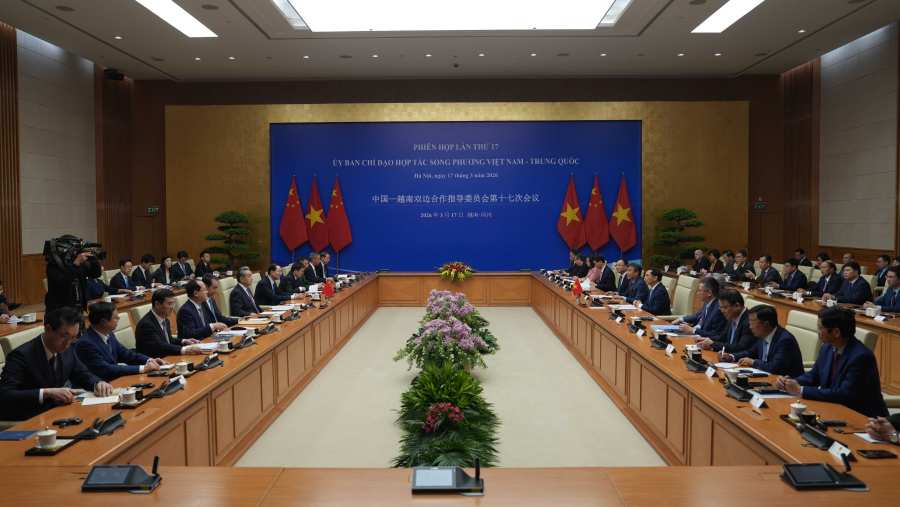
Bui Thanh Son congratulated China on its tremendous achievements in economic and social development, stating that under the personal guidance of the top leaders of both Parties and countries, Viet Nam-China relations have sustained strong momentum and yielded fruitful results. The two sides have maintained frequent high-level communication, steadily enhanced political mutual trust, deepened practical cooperation, and conducted increasingly active people-to-people and sub-national exchanges, bringing tangible benefits to their peoples. Viet Nam has consistently regarded China as a top priority and strategic choice in its foreign policy, and firmly adheres to the one-China policy and opposes any form of “Taiwan independence” separatist activities. The Vietnamese side agrees with China’s proposed vision for future cooperation and stands ready to uphold the positioning of the Viet Nam-China comprehensive strategic cooperative partnership, further consolidate strategic mutual trust, make solid preparations for high-level exchanges, strengthen party-to-party and parliamentary interactions, deepen cooperation in national defense and security, promote mutually beneficial collaboration in trade, agriculture, finance, green energy, and cultural education, enhance multilateral coordination, properly manage differences, and drive the Viet Nam-China relationship to greater depth and substance.
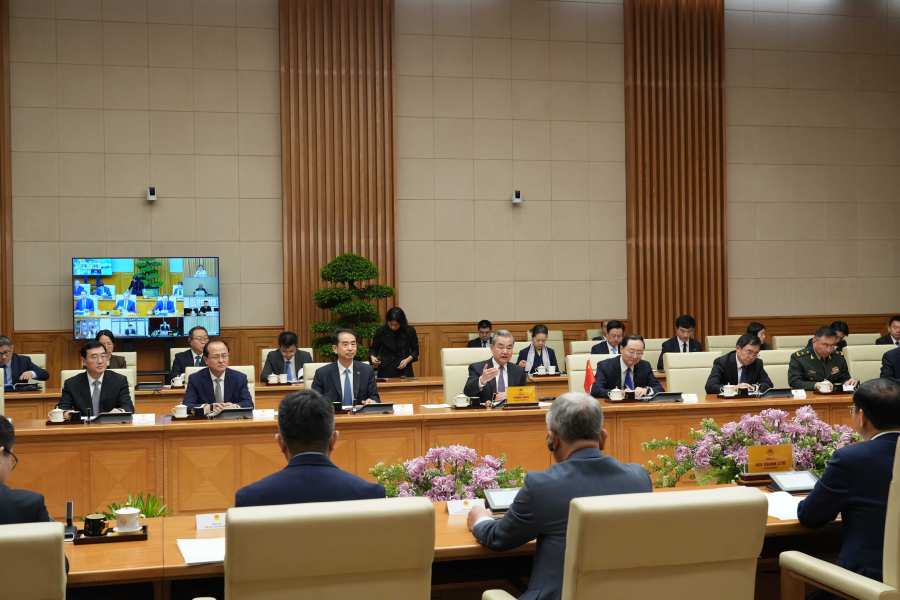
Furthermore, both sides agreed to continue leveraging the coordinating role of the Steering Committee, focus on the overarching goal of “six mores” in China-Viet Nam relations, consolidate consensus on cooperation across various fields, and promote the building of a China-Viet Nam community with a shared future of strategic significance to constantly reach new heights.