In 2023, Indonesia exported coconuts and their derivatives worth US$1.5 billion. The government has designated Lombok as a Center of Excellence for coconut downstream processing.
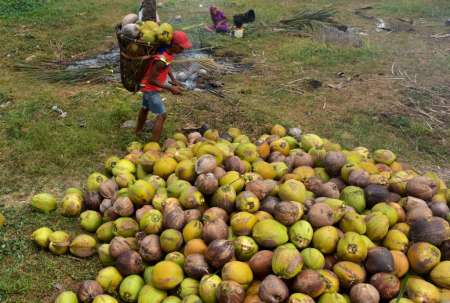
To expand the export market for coconuts, the government, through the Ministry of Industry, is developing the commodity through a downstream program. MC Tidore/Nhanu Tosofu
Besides palm oil, coffee, and cocoa, Indonesia also has another flagship commodity that plays an important role in the global market, which is coconuts. For instance, in 2022, Indonesia was able to produce 17,190,327 tons of coconuts, equivalent to 27% of the world's coconut production. In terms of exports, Indonesia managed to export coconuts and their derivatives worth US$1.5 billion in 2023.
This significant potential has not gone unnoticed by the government. To expand the export market for coconuts, also known as "nyiur," the government, through the Ministry of Industry, is developing the commodity through a downstream program.
Coconut (Cocos nucifera) is the sole species in the genus Cocos of the palm family (Arecaceae). The coconut palm is known as a versatile tree for tropical communities. Almost all parts of the tree can be utilized and have value in people's lives, from building materials to food and cosmetics.
In Indonesia, coconuts can be processed into various products such as cooking oil, coconut milk, copra, and coconut sugar. Coconuts are also a crucial raw material in the food processing, beverage, and cosmetic industries.
The flesh of the mature seed is regularly a food source for many people in tropical and subtropical regions. Coconuts are unique among fruits because their endosperm contains a large amount of clear liquid, called "coconut water," which, when immature, can be harvested for drinking.
The Ministry of Agriculture (Kementan), through the Agriculture Quarantine Agency (Barantan), mentioned that there are at least 13 types of coconut derivative commodities that are popular in the global market. These coconut-derived products have reached dozens of destination countries across six continents, from Asia, Europe, Australia, Africa, North America, and South America.
Almost all parts of the coconut have been exported, from the coconut flesh, coconut water, coconut shell, coconut husk, to the coconut trunk. Indonesia is noted to be the world's largest coconut producer, with major production centers over the past five years in Riau, North Sulawesi, East Java, North Maluku, and Central Sulawesi.
Riau contributes 395.5 tons or 11.92% of Indonesia's coconut production, followed by North Sulawesi with 271.1 tons (9.33%), East Java with 257.5 tons (9.17%), North Maluku with 240.8 tons (7.95%), and Central Sulawesi with 229.4 tons (6.77%). The remaining 54.86% comes from other provinces, including Lombok.
Potential in Lombok
According to Director General of Agro Industry Putu Juli Ardika, Lombok has abundant coconut potential. "This potential must be optimally utilized through the preparation of an integrated coconut downstream roadmap and the determination of the right business model to develop the integrated coconut development ecosystem. Currently, the Ministry of Industry (Kemenperin), together with relevant stakeholders, is preparing the roadmap," explained Dirjen Putu Juli Ardika during a working visit to Lombok, West Nusa Tenggara, on Tuesday (April 23, 2024).
Lombok is one of the areas considered capable of becoming a center of excellence as an example of good coconut processing. To support this, the government has allocated Special Allocation Funds (DAK) amounting to Rp16.8 billion to North Lombok Regency, to support the coconut processing industry from 2022 to 2024. In this region, coconut industry entrepreneur can produce Virgin Coconut Oil (VCO), coconut oil, and coconut flour.
Highlighting the importance of maintaining sustainable coconut cultivation land, Director General IA emphasized the need to consider space for other activities, ensuring that requirements such as agricultural land are not sacrificed. This can support and impact an inclusive and sustainable economy.
"The human resources also need to be considered to keep up with the times and consumer demands. We see the need for human resource training facilitated by the Industrial Human Resource Development Agency (BPSDMI) of the Ministry of Industry," he said.
Besides human resource challenges, the coconut industry also faces downstream sector challenges. Although it can produce coconut oil, Virgin Coconut Oil (VCO), and coconut flour, there are still several downstream products that could be developed. As stated by Zulhadi, one of the managers of the Coconut Processing Center in North Lombok Regency, "There are still many coconut by-products that can be further utilized. Therefore, there needs to be a development business model," he said.
So far, coconut-based product processing is mostly done on a home industry scale. The products produced include coconut oil, Virgin Coconut Oil (VCO), and coconut fiber crafts.
Source:Indonesia Information Portal
General Secretary and President To Lam hosts an official welcome ceremony for King of Thailand Maha Vajiralongkorn Phra Vajiraklaochaoyuhua at the headquarters of the National Assembly, Ha Noi, September 15, 2026 – Photo: VGP
15 September,2026