Manila, July 23(AseanAll) — The Philippines successfully concluded the four-day 59th ASEAN Foreign Ministers’ Meeting (AMM) and Related Meetings on July 23, 2026, with Philippine Foreign Affairs Secretary Ma. Theresa Lazaro as chair leading discussions on regional peace, security, economic cooperation, and ASEAN community-building under the country’s 2026 ASEAN Chairship.
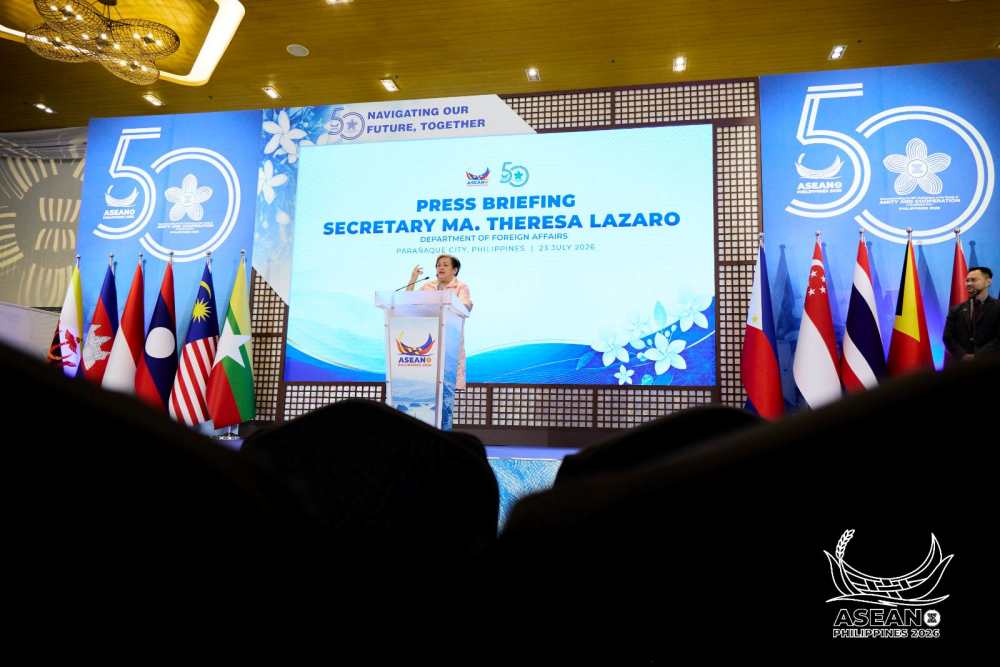
Addressing the media during a press conference at the International Media Center in Parañaque City, Lazaro said the series of high-level meetings brought together the 11 ASEAN member states and the bloc’s external partners to address key regional and global issues.
“Over the past four days, Manila has served as the center of ASEAN diplomacy as I chaired the 59th ASEAN Foreign Ministers’ Meeting and Related Meetings. These engagements brought together fellow ASEAN Foreign Ministers and our External Partners to discuss issues that matter most to our region,” Lazaro said.
Among the key outcomes of the 59th AMM was the adoption of the Joint Communiqué, which reflects ASEAN’s common positions and priorities on regional issues.
The ministers also adopted the Guidelines on the Modalities for Engagement of ASEAN with High Contracting Parties to the Treaty of Amity and Cooperation (TAC) in Southeast Asia, a Philippine Chairship priority that establishes a framework for deeper engagement between ASEAN and High Contracting Parties that do not yet have formal partnership arrangements with the regional bloc.
ASEAN foreign ministers likewise issued a statement on the evolving situation in the Middle East, calling on all parties to exercise utmost self-restraint and avoid actions that could further escalate tensions.
The meeting also welcomed Türkiye as ASEAN’s 12th Dialogue Partner and approved the conferment of Sectoral Dialogue Partner status on Germany and Qatar.
On Myanmar, ASEAN foreign ministers reaffirmed that the Five-Point Consensus remains the bloc’s primary framework for addressing the situation in the country while discussing ways to assess measurable progress in its implementation, including the possibility of a multi-year Special Envoy.
“During the Extended Informal Consultation on the Implementation of the Five-Point Consensus, I had candid and focused discussions on ASEAN’s current engagement with Myanmar,” Lazaro said.
“Building from our informal discussions in Bangkok last week, we discussed how ASEAN could assess measurable progress in Myanmar, including the prospect for a multi-year Special Envoy. In all of these discussions, ASEAN member states reaffirmed that the Five-Point Consensus remains the primary reference of ASEAN in addressing the crisis,” she added.
Through the Post-Ministerial Conferences (PMC) with ASEAN’s 11 Dialogue Partners, ministers reviewed progress under their Comprehensive Strategic Partnerships and discussed ways to deepen cooperation in maritime security, connectivity, trade and investment, digital transformation, cybersecurity, energy and food security, disaster management, climate action, and people-to-people exchanges.
ASEAN also held trilateral meetings with Türkiye, Norway, Switzerland, and Brazil, reflecting the growing interest of its partners in expanding cooperation with the regional bloc.
The meetings also included the ASEAN Plus Three Foreign Ministers’ Meeting, where ASEAN, China, Japan, and the Republic of Korea reaffirmed their commitment to strengthening regional resilience, supply chains, food and energy security, and practical cooperation amid global uncertainties.
Lazaro also chaired the 33rd ASEAN Regional Forum (ARF), where participants adopted the Manila Plan of Action (2026-2036), which will guide the forum’s work over the next decade, and welcomed the United Kingdom as the ARF’s 28th participant.
The AMM-PMC concluded with the 16th East Asia Summit Foreign Ministers’ Meeting, where ministers called for stronger practical cooperation in addressing geopolitical tensions, transnational challenges, and emerging technologies, while advancing preparations for the 21st East Asia Summit, which the Philippines will host in Manila this November.
“Taken together, these meetings demonstrate ASEAN’s enduring convening power and its ability to foster dialogue, strengthen partnerships, and build consensus at a time of increasing geopolitical uncertainty,” Lazaro said.
“While we have accomplished much over the past four days, our work under the Philippine Chairship continues,” she added.
The ministerial meetings in Manila will conclude with the commemoration of the 50th anniversary of the Treaty of Amity and Cooperation in Southeast Asia on Friday, during which Sweden, Poland, Romania, and Lithuania are expected to accede as new High Contracting Parties.
ASEAN will also convene the inaugural High-Level Conference of High Contracting Parties—the first gathering of its kind since the treaty was signed in 1976—to discuss conflict prevention and preventive diplomacy, maritime security and cooperation, and emerging regional challenges.
“The Philippines is honored to lead this important milestone as ASEAN Chair and committed to sustaining the momentum of our Chairship,” Lazaro said.
Lazaro meanwhile commended the National Organizing Committee for the successful hosting of the ministerial meetings, noting that Manila had become “a venue for the powers to meet and to talk to each other” over the past four days.
She cited bilateral meetings among top diplomats, including those involving US Secretary of State Marco Rubio, Chinese Foreign Minister Wang Yi, and Russian Foreign Minister Sergey Lavrov, as evidence of the Philippines’ role in facilitating dialogue.
“Actually, me alone, I had about 38 bilateral meetings. And for the whole foreign ministers, I heard it’s about 120 bilateral meetings,” Lazaro said.
“That shows also the respect for the Philippines from many of these ministers. And if you scour the news all over the world, Manila is in the headline,” she stressed.