Hanoi, May 2 (AseanAll) — Viet Nam and Japan have concurred to procure crude oil for the Nghi Son Refinery – one of the two oil refinery plants in Viet Nam, said Japanese Prime Minister Takaichi Sanae on May 2, 2026, according to Vietnamese government portal(VGP) .
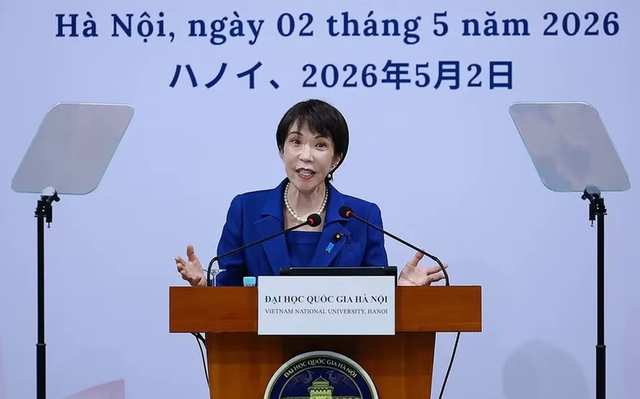
Japanese Prime Minister Takaichi Sanae delivers a policy speech at the Viet Nam National University in Ha Noi, May 2, 2026
The procurement of crude oil for the Nghi Son Refinery plant is the first project of POWERR Asia, launched at the recent Asia Zero-Emission Community (AZEC) Plus online Summit, in order to maintain production and supply chains of important materials.
Located about 260km away from Ha Noi capital, the refinery has capacity to process 200,000 barrels imported from Kuwait per day.
In the medium- and long-term, Japan will help Viet Nam to build regional oil stockpiling and release systems, advance energy conservation, an develop and disseminate new energy sources such as biofuels, next-generation solar power, nuclear energy and LNG to power, Takaichi told students at the Viet Nam National University in Ha Noi on May 2.
Beyond energy, Japan seeks to move forward together with Viet Nam in developing artificial intelligence (AI) as it is becoming an indispensible part of our daily life, Takaichi said.
In October 2025, Japan announced the "ASEAN-Japan Co-Creation Initiative for AI" with an aim to develop AI models reflecting Asia's diverse languagues and cultures.
Takaichi, who is on a three-day official visit to Viet Nam, said Japan will coordinate with Viet Nam as the chair of the Comprehensive and Progressive Trans-Pacific Partnership (CPTPP), to promote the expansion of CPTPP.
Japan aims for early commencement of accession processes for strategically important applicants such as the Philippines, Indonesia, and the United Arab Emirates, she added.
Regarding semiconductor industry, Takaichi said Viet Nam and Japan share common ground in what is often called the "rice of industry" – semiconductors. Both countries are also advancing cooperation in cultivating highly skilled industrial talent in this area.
Last year, the "Semiconductor Chip Technology Engineer Program" "was newly established at the Viet Nam-Japan University, a part of this Viet Nam National University. This program is expected to contribute not only to Viet Nam's industrial advancement but also to the strengthening of Japan's semiconductor supply chain.
Takaichi expressed her hope that the Viet Nam-Japan University, as a symbol of Japan-Viet Nam cooperation, will further develop into a hub for nurturing and supplying talented individuals who will contribute not only to our two countries but also to the wider Indo-Pacific region, beginning with the field of semiconductors.