(AseanAll) — On March 15, 2026, Thai Prime Minister and Minister of Interior Anutin Charnvirakul chaired the 4/2026 meeting of the Joint Management and Monitoring Center for the Situation in the Middle East. Participating in the meeting, either onsite or online, were Deputy Prime Minister and Minister of Finance Ekniti Nitithanprapas, Minister of Commerce Suphajee Suthumpun, Deputy Prime Minister and Minister of Transport Phiphat Ratchakitprakarn, and Minister of Energy Auttapol Rerkpiboon, as well as representatives of agencies related to national security, tourism, labor, and the private sector.
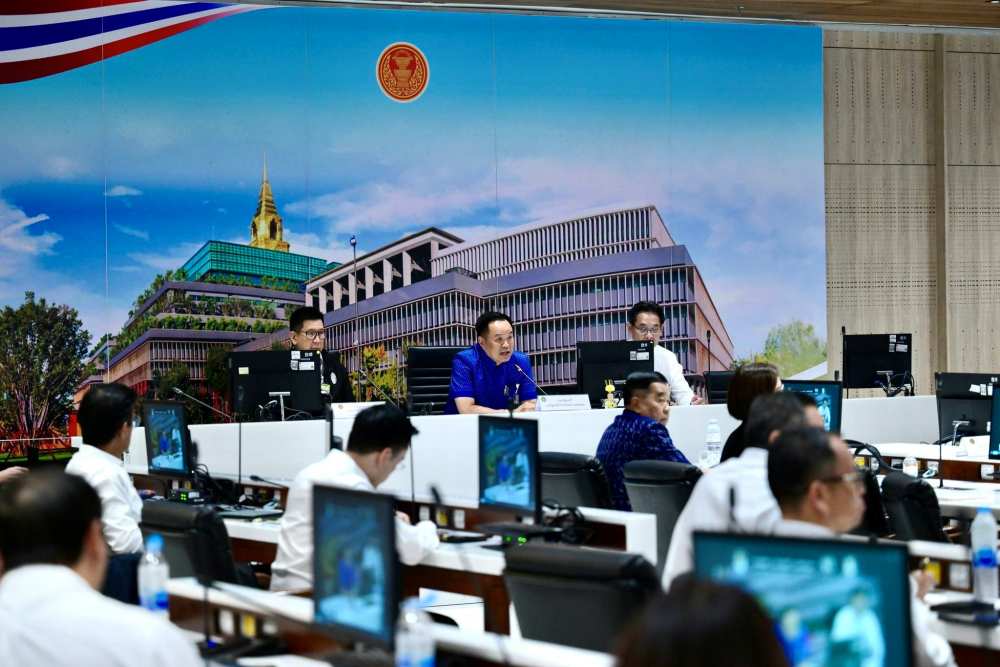
The Prime Minister reaffirmed that the country’s energy situation is not in crisis. Fueling at service stations continues as normal. Over the two weeks of the Middle East conflict, Thailand has not experienced any shortage of gasoline. Information circulating on social media may have caused public concern and misunderstanding on the possibility offuel shortage, but in fact, these were only internal management measures by companies. He has already instructed relevant agencies to urgently communicate accurate information to the public. Major oil operators are also called on to build public confidence that domestic oil supplies remain sufficient and that there is no impact on people’s daily lives.
The Prime Minister also urged oil traders to ensure appropriate gasoline management and distribution, and exercise their judgment to limit sales if abnormal bulk purchases occurred to avoid the impact onregular consumers. At the same time, he suggested the separation offueling channels for industrial sectors or large-scale construction projects, that require significant volumes of fuel, to be carried outthrough wholesale systems or direct delivery into the agencies’ storage tanks, rather than refueling at service stations. This is to help ease congestion and reduce public concern.
Meanwhile, Thailand’s energy agencies continue to secure oil supplies from diverse sources worldwide. Negotiations are also underway to purchase gas and fuel from countries outside the Middle East region todiversify the nation’s energy risk. The Prime Minister emphasized thatthe top priority now to communicate accurate information in a bid to minimize public panic. He also reaffirmed that Thailand shows no signs of imminent oil shortage.
Thai Deputy Prime Minister and Minister of Finance stated that Thailand’s oil reserves remain sufficient as the country’s current crude oil stockcould last approximately 96 days. The challenge, however, lies withlogistics and distribution management which could affect public confidence. He compared the situation to an ATM with large reserves of cash, but if people panic and simultaneously withdraw cashes, it may create a false impression of money insufficiency.
The following 3 key measures was discussed at the meeting: 1) Communicating clearly and accurately with the public to build their confidence on sufficiency of oil supplies; 2) Managing logistics and distribution to ensure efficient delivery of fuel to service stations; and 3) Establishing separate supply channels for industrial sectors to minimize their reliance on service stations intended for the general public, reduce congestion, and ease public concern.
At the meeting, major oil traders, i.e., PTT, OR, PT, and Bangchak, confirmed that oil reserves remain sufficient. They also expressed support for the Government’s policy implementation, and called for appropriate management of logistics and distribution of gasoline at service stations.
Thai Minister of Commerce highlighted Thailand’s trade opportunities. Amid the current crisis, many Middle Eastern countries are experiencing an increasing demand for food, both raw and processed food, which would be a good opportunity for Thai entrepreneurs and food exporters. However, shipping constraints pose risks, especially for vessels passing through the Strait of Hormuz. She, therefore,proposed negotiation establishment with the Iranian Government to facilitate Thai cargo vessels. If negotiations succeed, Thailand would be able to expand food and processed food exports to Middle Eastern markets, while also importing energy and fertilizers from the region back to Thailand.
Thai Minister of Energy also reaffirmed that fuel supply at service stations nationwide continues as normal. Throughout the two weeks of Middle East tensions, Thailand has not faced any oil shortages. Public concern has partly arisen from bulk purchases intended for stockpiling and circulation of misinformation online. Relevant agencies and energy operators have already been urged to communicate accurate information to the public. The Minister also confirmed that Thailand continues sourcing oil and gas from multiple global suppliers, with no sign for an imminent energy crisis.
The representative from Ministry of Foreign Affairs of Thailand shared with the participants the latest developments in the Middle East. Tensions in the Strait of Hormuz continue to escalate, with oil shipments affected at certain times. Major powers have begun discussing measures to tackle the situation, including negotiations with Iran to ensure safe passage for cargo vessels.
Regarding the Mayuree Naree cargo vessel, on March 14, 2026, vessel’s owner has already evacuated 20 crew members from Khasab, United Arab Emirates, to Oman’s Muscat. The Royal Thai Embassy in Muscat has provided close assistance, and all crew members are scheduled to arrive Thailand today (March 16, 2026). However, the last 3 crew members still need to be assisted. Minister of Foreign Affairs has coordinated with the Iranian counterpart to expedite the assistance.
In closing, the Prime Minister instructed all agencies to put utmost effort in safeguarding the nation’s energy situation and people’swellbeing. He reaffirmed the Government’s commitment to ensuring fuel security and availability of essential supplies, and maintainingnormalcy and stability of the overall situation.